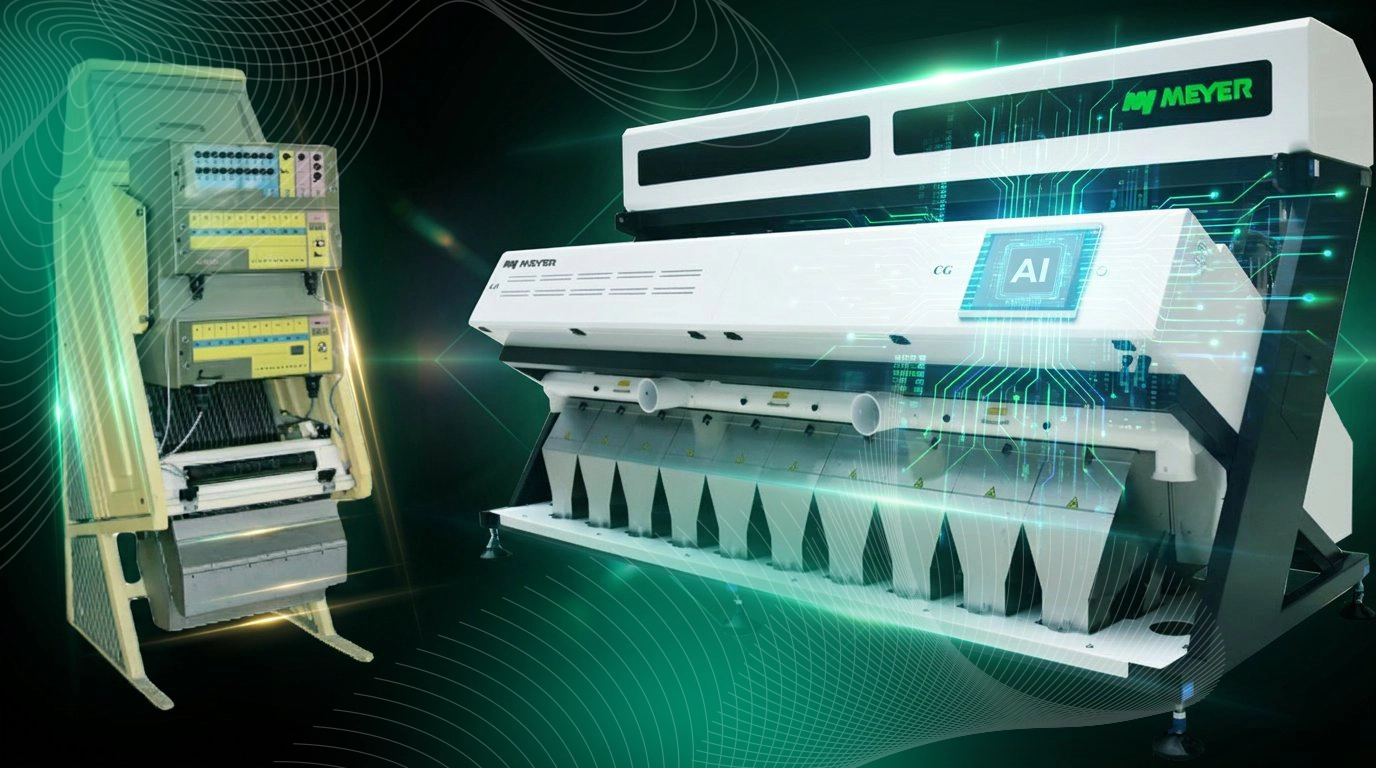
Grain, the Eye, and Patience
Before any machine existed, quality was always checked by a human. Imagine a scene from one hundred, two hundred, or even thousands of years ago: a farmer or a worker sitting at a table, running grain through their hands, picking out with their eyes what should be discarded: a stone, a damaged kernel, a remnant of husk. It was monotonous, eye straining, and incredibly time consuming work, but for centuries, it was the only available method for ensuring quality.
Manual selection had one fundamental weakness: it depended on human perception, and perception is fickle. Fatigue, poor lighting, and the monotony of repetitive movements all impacted effectiveness. Despite this, this method lasted longer than any other and still functions today in many parts of the world where the scale of production does not justify the investment in automation.
The First Mechanical Attempts: The Power of Physics to the Rescue
The Industrial Revolution brought the first attempts at mechanizing selection: sieves, shakers, and gravity separators that utilized differences in weight, density, and size. This was a huge leap forward in terms of efficiency, but it was still very limited. These machines could distinguish big from small or heavy from light, but they had no concept of color, surface defects, or internal damage. Furthermore, a human was still needed as the final line of quality control.
1947 – The Birth of Optical Sorting
The breakthrough came in the mid-20th century when engineers began experimenting with photocells – simple sensors that reacted to light. The first devices of this type, used mainly in the food industry (e.g., for sorting beans or peas), worked on a very basic principle: they detected the difference in hue between a “good” product and a darker contaminant, after which a stream of air removed the unwanted element from the line.
This was the moment when, for the first time, a machine began to “look” at the product, rather than just reacting to its mass or size. Photocells were primitive compared to today’s systems. They recognized mainly black and white contrast or simple shade differences, but conceptually, they opened the door to everything that followed.
The Era of Cameras and Digital Image Processing
The 1980s and 90s were a time when the development of electronics and computer science enabled the use of real cameras in sorting processes. Instead of a single photocell reacting to one parameter, machines began to “see” the entire image of the product – its color, contour, and surface texture. Computers, though still computationally limited by today’s standards, were already able to analyze images in real-time and make decisions dozens of times per second.
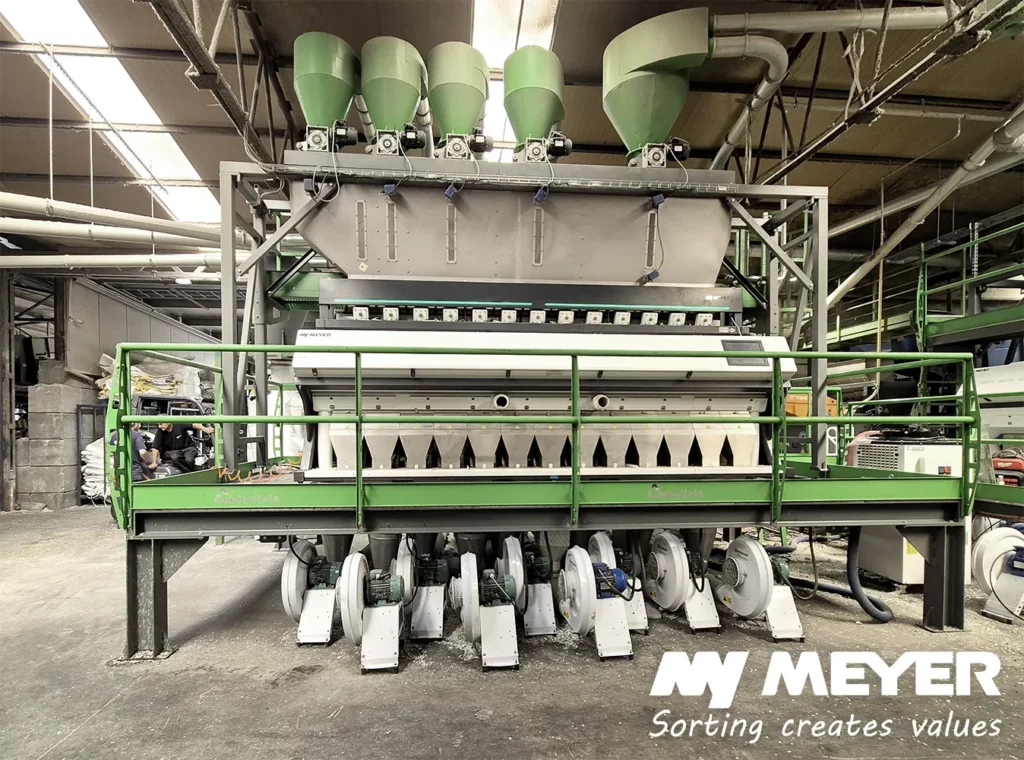
It was at this stage that optical sorting began to resemble the technology we know today: line scan cameras, lighting with specific characteristics, and pneumatic nozzles removing contaminants with incredible precision. The food industry, fruit and vegetable processing, and the recycling industry all began to discover that a machine could perform the work of many pairs of human eyes simultaneously, without losing concentration after an eight hour shift.
Seeing Beyond the Human Eye
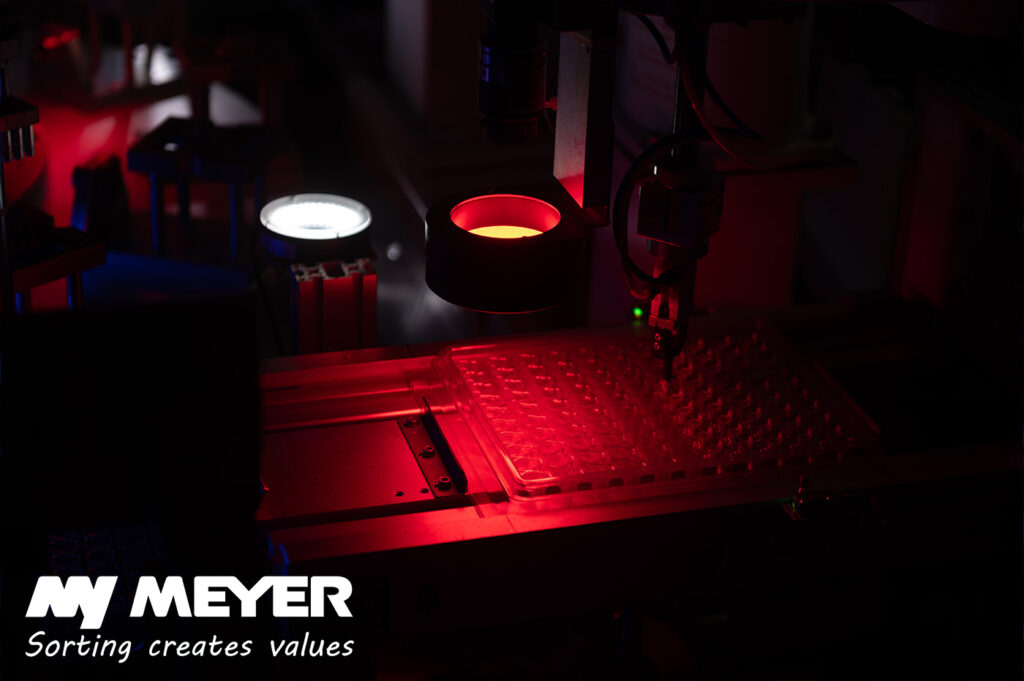
The next step was to go beyond what a human sees. The introduction of cameras working in Near Infrared (NIR), as well as multispectral and hyperspectral technology, allowed machines to detect differences invisible to the human eye, such as internal product damage, early stages of mold, or differences in chemical composition and moisture. The sorter was no longer just a “better eye,” but an analytical tool that provided information previously unattainable in any other way.
This was the moment when optical sorting stopped competing with humans on the same terms and began offering a completely new level of control. Unattainable before, regardless of an employee’s experience or attention.
Artificial Intelligence and Machine Learning
The latest, ongoing revolution is the entry of machine learning algorithms. Earlier systems operated on rigidly programmed rules: “if the pixel is darker than value X, reject the object.” Today’s systems, based on neural networks, “learn” from thousands of examples, recognizing patterns too complex to describe with a simple rule.
As a result, a machine can, for example, learn to distinguish a natural, acceptable discoloration from a defect that requires rejection. It is a level of discrimination that previously required an experienced human eye. Moreover, these systems can be trained in real time, adapting to a changing batch of raw material or a new type of contaminant that has never appeared before.
From Sifting Stones to Millisecond Decisions
Looking at this history from a distance, a clear line of development emerges: from physical separation, through simple contrast detection, to intelligent systems that analyze images in a spectrum inaccessible to the human eye and make decisions at a speed impossible for a human to achieve. Each stage of this evolution answered the same question the farmer sifting grain through their hands asked: how to separate the valuable from that which should not move forward. The fundamental difference is that machines can do it faster, more precisely, and without fatigue.
What began as a simple necessity is now one of the most advanced fields of industrial automation, combining optics, electronics, and artificial intelligence into one smoothly operating process.
Modern Technologies Serving Optical Sorting
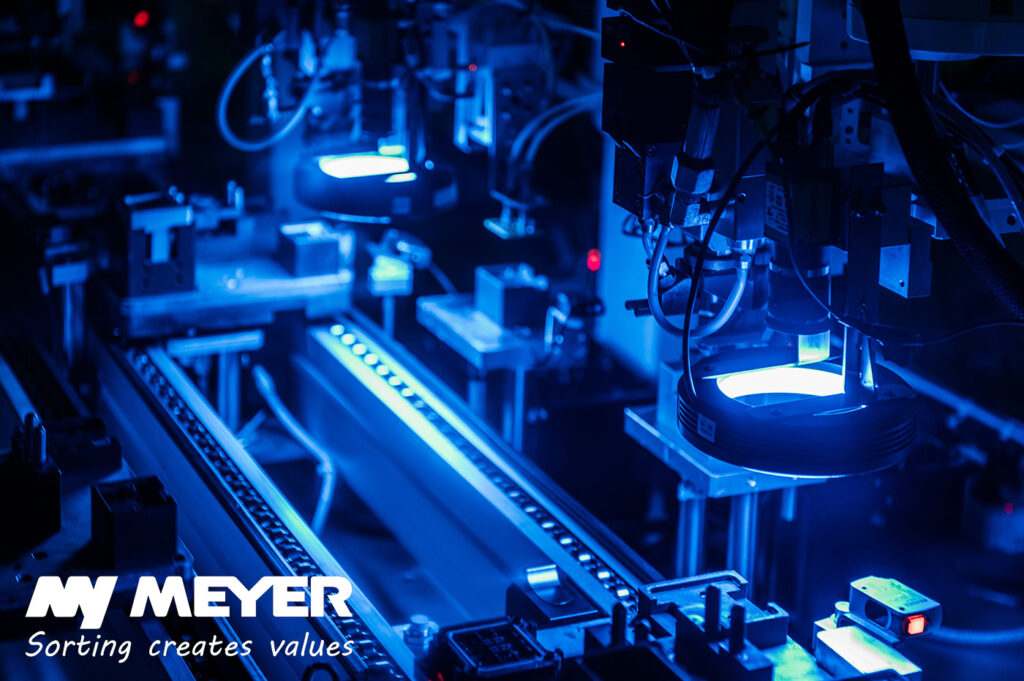
What started as a simple optical electrostatic setup has evolved over the decades into increasingly advanced systems:
- Color cameras and line-scan cameras replaced simple sensors, enabling the detection of much subtler color and texture differences.
- Near Infrared (NIR) technology allowed machines to “look” under the surface of the product to detect moisture, chemical composition, or damage invisible to the naked eye.
- Hyperspectral cameras expanded the detection range to dozens or even hundreds of light bands simultaneously.
- Maglev ejectors – beyond cameras, the ejection itself matters. Modern air systems precisely remove defective particles from the stream without wasting good material.
- Artificial Intelligence and Deep Learning technology, present in the latest generations of sorters, allow the machine to independently “learn” to recognize new types of defects based on thousands of analyzed images, without the need for manual programming of every parameter.
Summary
The history of sorting is, in essence, the history of gradually transferring one human skill to machines: first strength and endurance, then sight, and today, the ability to learn and make decisions. From a single worker sifting grain by hand, through mechanical sieves, photocells, and cameras, to systems utilizing artificial intelligence and precision air ejectors. Every stage of this journey answered the same question: how to distinguish good from defective faster, more accurately, and on a larger scale. What began as a purely human task has today become one of the most technologically advanced fields of industrial automation.