What Is Fusarium contamination in wheat?
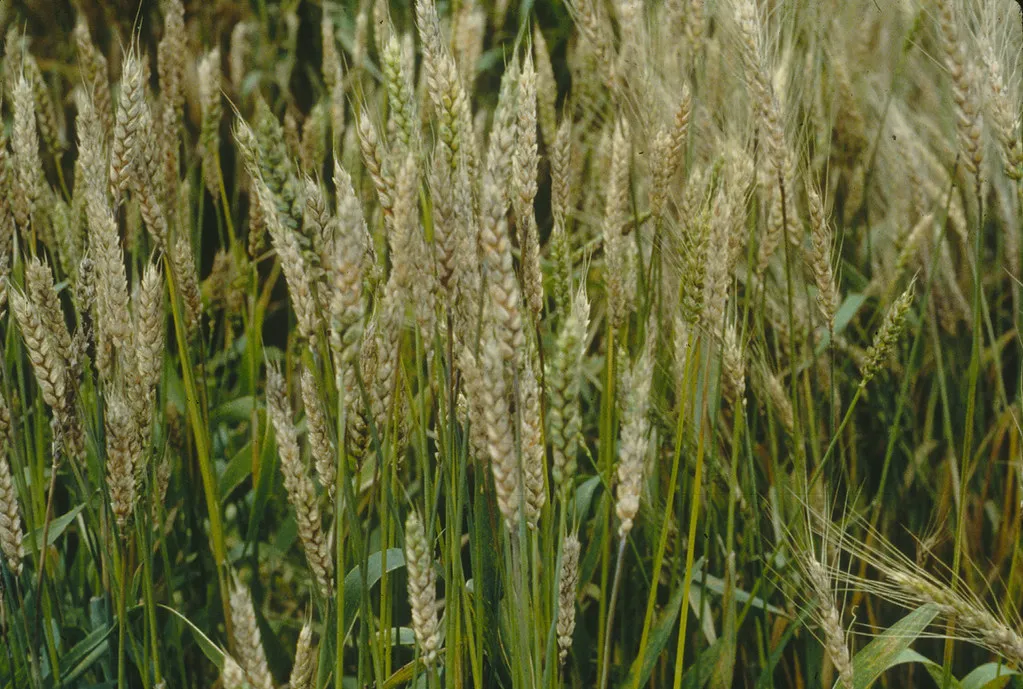
Fusarium head blight is a fungal disease affecting wheat and other small grains. It commonly occurs in wet, humid conditions around flowering time. The infection is caused by Fusarium species (such as F. graminearum or F. culmorum) that invade the developing wheat heads. Infected wheat kernels often become shriveled, lightweight, and discolored, taking on a chalky white or pinkish appearance due to the fungal growth. These visibly affected grains are referred to as Fusarium-damaged kernels (FDK), or “scabby” kernels in the U.S. Such kernels typically have lower weight and poor milling quality.
Examples of Fusarium-damaged wheat kernels (right) compared to healthy kernels (left). Infected kernels tend to be shriveled, chalky white or pinkish, with fibrous fungal growth, whereas healthy kernels are plump and uniformly colored.
A major concern with Fusarium infection is the production of mycotoxins. As the fungus grows on the grain, it produces toxic compounds – most notably deoxynivalenol (DON), commonly called vomitoxin. DON and related toxins accumulate in the grain during infection. Consuming grain with high DON levels is harmful to humans and animals, causing symptoms like nausea, vomiting, and other gastrointestinal distress. For this reason, strict regulatory or advisory limits on DON are in place in many countries to protect food and feed safety. Processors must keep DON levels low, and grain shipments with too many Fusarium-infected kernels or excessive toxin levels can be downgraded or rejected. In short, Fusarium contamination not only reduces crop yield in the field but also threatens the safety, quality, and marketability of wheat in the supply chain.
Why fusarium contamination is a problem
Fusarium infection impacts the wheat supply in several ways:
- Health Risks: Fusarium fungi produce DON and other toxins (like zearalenone) that pose risks to food and feed. Eating products made from contaminated wheat can cause acute illness in people and livestock. Even at lower doses, these toxins may reduce livestock performance (for example, pigs may eat less feed if it contains DON). Ensuring these mycotoxins are kept out of the food chain is paramount for public health.
- Quality and Yield Loss: Infected kernels are often damaged and lightweight, leading to lower flour yield and baking quality. A high percentage of FDK in harvested grain means less saleable product – FHB outbreaks can significantly cut yields and test weights. The milling process is also less efficient with diseased kernels, and flour color or functionality may be affected by their presence.
- Economic Impact: Most grain buyers and food processors have strict limits on FDK and DON. For example, only a small percentage of Fusarium-damaged kernels is tolerated in wheat intended for human food. If a load exceeds those limits, its grade is lowered or it may be rejected entirely, costing the supplier money and logistics delays. Likewise, processors face costly recalls or regulatory actions if a contaminated product reaches consumers. Thus, there is strong economic incentive to detect and remove Fusarium-infected wheat early in processing.
In summary, Fusarium contamination is both a food safety issue and a quality issue. It demands effective control measures from farm to mill to prevent tainted grain from entering food products.
Limitations of traditional detection methods
Identifying and removing Fusarium-infected kernels has historically been challenging. Traditional methods include visual inspection and basic mechanical cleaning, but these approaches have significant limitations:
- Visual Grading and Hand Sorting: Grain inspectors often visually examine a sample of wheat for FDK – looking for the telltale chalky or pinkish, shrunken kernels. While this can give an estimate of Fusarium presence, it’s labor-intensive and subjective. Manually picking out scabby kernels from large quantities of grain is impractical. In fact, visual sorting is prone to human error and inconsistency; different inspectors may not agree, and fatigue can cause mistakes. Small or mildly infected kernels might be overlooked, especially when thousands of kernels are passing by each minute.
- Laboratory Testing: To detect mycotoxins like DON, processors rely on lab tests (e.g. rapid test kits or chromatography) on grain samples. While lab testing accurately measures toxin levels, it’s slow and performed on only a small sample of the lot. There is a risk that hotspots of contamination go undetected if they weren’t in the tested sample. Moreover, testing doesn’t physically remove the bad kernels; it only informs whether a lot is over the limit. At that point, the grain may already be in the supply chain, and blending or cleaning becomes necessary to salvage it.
- Mechanical Cleaning Equipment: Standard cleaning equipment in mills (such as sieves, aspirators, and gravity tables) can remove some Fusarium-damaged kernels indirectly. Heavily infected kernels are often smaller, lighter, or more shriveled, so gravity separators and aspirators will kick out some of these low-density kernels. However, these machines are not foolproof Fusarium detectors – some infected kernels have size/weight similar to healthy grain and will slip through. Conversely, some good kernels may be discarded in the attempt to remove bad ones, leading to product loss. Mechanical methods also cannot “see” the actual fungal infection or toxin; they only segregate by physical properties, which is an imperfect proxy.
Given these limitations, it’s clear that relying on traditional sorting and testing may leave processors vulnerable to contaminated kernels ending up in flour or other end products. What’s needed is a faster, more precise way to spot and eliminate Fusarium-infected grain in the processing line. This is where modern optical sorting comes in.
MEYER Optical Sorters: A leading solution for Fusarium control
When it comes to optical sorting in the food industry, MEYER is a name that stands out as an innovator. MEYER’s optical sorting machines are widely used in grain processing for their accuracy, efficiency, and advanced features tailored to food safety challenges like Fusarium contamination. Below, we highlight how MEYER optical sorters specifically help prevent Fusarium-infected wheat from entering the food supply:
- Multi-Sensor Inspection: MEYER optical sorters leverage a combination of full-color cameras and multispectral system to scrutinize each grain. The high-resolution cameras capture fine color details, easily spotting kernels with the off-color hues or whitened appearance caused by Fusarium infection. In addition, MEYER offers models equipped with infrared (IR) cameras and even ultraviolet detection, forming a multispectral system that can detect defects beyond the visible spectrum. This means a MEYER sorter can pick up on hidden fungal presence or “invisible” damage inside a kernel, which pure optical (visible-light) systems might miss. The integrated vision system in MEYER machines can evaluate color, shape, density, and texture simultaneously, allowing for precise identification of Fusarium-damaged kernels from multiple angles.
- AI-Powered Recognition: A standout feature of MEYER’s technology is the use of artificial intelligence (AI) and deep learning algorithms in sorting. Instead of relying only on static pre-set thresholds, MEYER sorters are equipped with AI that has been trained on vast libraries of grain images. The system “learns” the subtle patterns that distinguish a slightly Fusarium-infected kernel from a healthy one – such as slight wrinkling, a touch of pink near the germ, or a certain shape profile. This AI-driven approach leads to extremely high classification accuracy, even for very small or early-stage defects. According to MEYER, their AI system can identify defects on the scale of a single pixel difference in an image. In practical terms, MEYER optical sorters can more reliably detect Fusarium-contaminated kernels while minimizing false rejects (good kernels thrown out by mistake). This intelligent sorting reduces waste and ensures you’re only removing kernels that truly need removal.
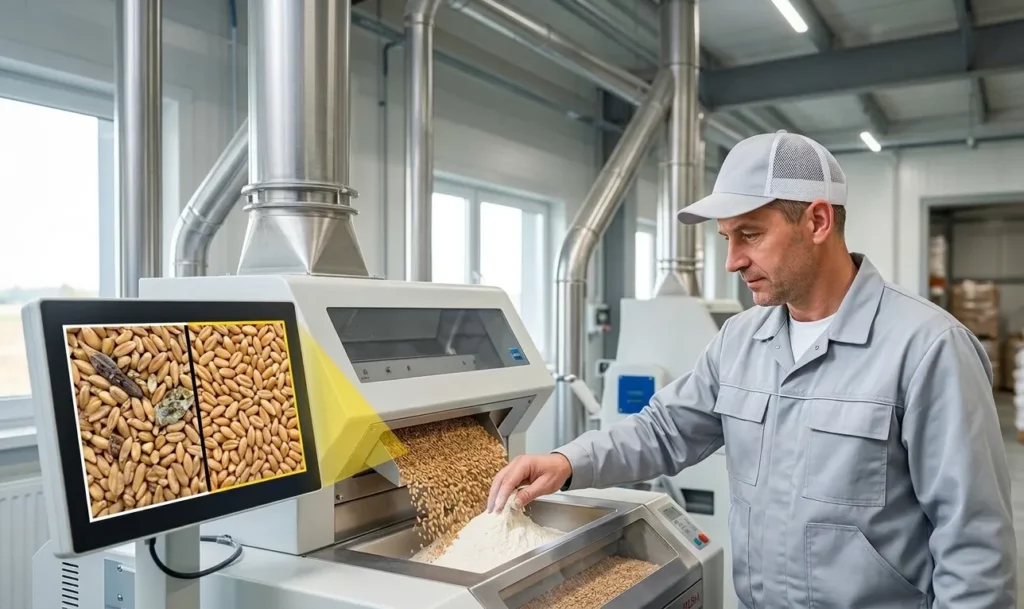
- Effective Mold and Toxin Removal: MEYER’s machines have proven effective at rejecting moldy and discolored kernels from grain. For instance, the MEYER CG series chute sorter is capable of effectively rejecting moldy, discolored, broken, and other impurities. In the context of Fusarium, this means the sorter will target the visual mold signs (whitish or pink fuzz on the kernel) and the discoloration associated with scab. By kicking out these kernels, a MEYER sorter substantially reduces the Fusarium load. Industry usage and case studies report that installing optical sorters upstream in the milling process leads to flour with significantly lower DON levels, because the source of the toxin (the infected kernels) has been largely removed ahead of time. This preventative removal is far more efficient than trying to blend or dilute contaminated grain after the fact.
- High Throughput & Precision Ejection: In industrial grain processing, speed matters. MEYER optical sorters are designed for high throughput – certain models can process several tons of wheat per hour while maintaining meticulous inspection of each kernel. For example, even a compact MEYER sorter (M2 model) can handle up to ~2 tons/hour with over 99.9% sorting accuracy in separating good vs. defective kernels. Critical to this performance are MEYER’s patented Maglev Ejectors®, which are ultra-fast, contact-free air valves that remove bad kernels with pinpoint precision. These ejectors operate at up to 1200 ejections per second, opening and closing in milliseconds. The benefit is twofold: even at high belt speeds, no contaminated kernel escapes the detector without being expelled, and the ejectors are so precise that very few good kernels get accidentally removed. This efficiency means processors don’t have to sacrifice large volumes of product to achieve safety – MEYER sorters minimize good grain loss while maximizing contaminant removal.
- Customizable and User-Friendly: MEYER understands that every processing plant has unique needs. Their optical sorters come with flexible settings and programs that can be tailored to the degree of Fusarium challenge. Operators can adjust sensitivity, define what level of discoloration triggers rejection, and even save multiple sorting modes for different wheat varieties or conditions. Despite the advanced technology under the hood, MEYER machines feature a simplified, intuitive interface for operators. This makes it practical for food industry staff to monitor and tweak the sorting process without specialized technical training. Remote monitoring and diagnostics are also available, meaning MEYER’s support team can assist with tuning the machine to target Fusarium if needed, or troubleshoot issues quickly to minimize downtime.
In combination, these features make MEYER optical sorters a leading solution for Fusarium contamination control. They bring together sensor technology and intelligent software to achieve what manual methods simply can’t – near-flawless removal of infected kernels at industrial scale. The table below summarizes some key features and how they specifically help in detecting Fusarium-infected wheat:
Features of modern optical sorters for Fusarium detection
| Feature | Role in Identifying Fusarium-Contaminated Kernels |
| High-Resolution Color Cameras | Detects subtle color differences on each kernel. Fusarium-infected wheat often appears bleached, pale, or has pinkish mold tints; high-res RGB cameras spot these discolorations that human eyes might miss at high speeds. |
| Shape & Size Analysis | Identifies shriveled or misshapen kernels. Fusarium damage typically causes kernels to be smaller, thinner, or distorted. The sorter’s vision system measures each kernel’s shape and filters out those that deviate from the normal healthy profile. |
| Near-Infrared (NIR) Sensors | Reveals internal or invisible signs of Fusarium infection. NIR can detect kernels with abnormal composition or hidden fungus that do not show obvious visual symptoms. This spectral analysis adds an extra layer of detection for infected kernels that look normal to the naked eye. |
| AI Detection Algorithms | Learns and recognizes complex patterns of Fusarium damage. Advanced sorters like MEYER’s use AI models trained on thousands of kernel images. This improves accuracy in distinguishing truly contaminated kernels from innocuous blemishes, reducing false positives and ensuring consistent removal of Fusarium-afflicted grain. |
| High-Speed Air Ejectors | Removes bad kernels swiftly and precisely. Powerful air jets, synchronized to sensor decisions, kick out Fusarium-infected kernels in milliseconds. The precision of systems like MEYER’s Maglev ejectors means only the target kernel is removed, with minimal loss of surrounding good kernels. Even at several tons per hour throughput, no contaminated kernel is missed due to the rapid response. |
| Full-Spectrum Lighting | Enhances detection of subtle symptoms. Controlled lighting (using full-spectrum LEDs) in the sorter illuminates wheat kernels to mimic natural light, making differences in color or mold growth more pronounced to the cameras. This consistent lighting ensures that features like the faint pink hue of Fusarium mold are picked up reliably, improving overall detection rates. |
Conclusion
Fusarium contamination in wheat is a persistent challenge for the food processing industry – it threatens food safety, reduces grain quality, and can lead to significant economic losses. Traditional methods of detecting or removing Fusarium-infected kernels have often fallen short, but modern optical sorting technology offers a robust solution. By using high-tech cameras and intelligent algorithms, optical sorters can identify and eliminate Fusarium-damaged kernels with unprecedented precision, helping to protect consumers from harmful mycotoxins like DON and preserving the quality of wheat-based products.
MEYER’s optical sorters exemplify the capabilities now available to millers and grain processors. With multi-spectral cameras, AI-driven defect recognition, and ultra-fast rejection systems, MEYER machines are able to dramatically reduce Fusarium contamination in processed wheat – all while maintaining high throughput and yield of good product. Processors that implement such optical sorting systems gain an important layer of protection: they can confidently deliver flour and other wheat products that meet stringent safety standards and quality specs.
Investing in optical sorting is increasingly becoming standard practice in the grain industry’s fight against mycotoxins. It acts as a critical CCP (Critical Control Point) in food safety plans, removing contaminants before they end up in final food products. In short, advanced optical sorters like MEYER’s help ensure that the wheat that goes into our breads, pastas, and cereals is clean, safe, and Fusarium-free. This technology not only safeguards public health but also gives food industry professionals peace of mind and a competitive edge in delivering high-quality, safe products to the market.
References
- Canadian Grain Commission – Identifying wheat and barley seed affected by Fusarium head blight grainscanada.gc.cagrainscanada.gc.ca. (Describes Fusarium head blight, Fusarium-damaged kernels, mycotoxin production, and economic impacts.)
- Wegulo, S.N. & Dowell, F.E. (2008). Near-infrared versus visual sorting of Fusarium-damaged kernels in winter wheat. Can. J. Plant Sci. 88:1087–1089 ars.usda.govars.usda.gov. (Notes that FHB causes shriveled/discolored kernels, reduces yield and quality, produces mycotoxins like DON and zearalenone, and discusses limitations of visual sorting vs NIR sorting.)
- Carmack, W.J. et al. (2020). Optical sorter-based selection effectively identifies Fusarium head blight resistance in wheat. Front. Plant Sci. 11:1318 frontiersin.orgfrontiersin.org. (Reports that optical sorting was effective at reducing DON toxin and Fusarium-damaged kernels, and details DON’s harmful effects on humans/animals.)